
01
Getting started #
From your first launch to your first annotation.
Launch and find the toolbar
After launching FloatInk, find its icon in the Windows system tray, including the hidden-icons area. Open its context menu and enable Show toolbar. Ctrl + Alt + H also shows or hides the toolbar by default.
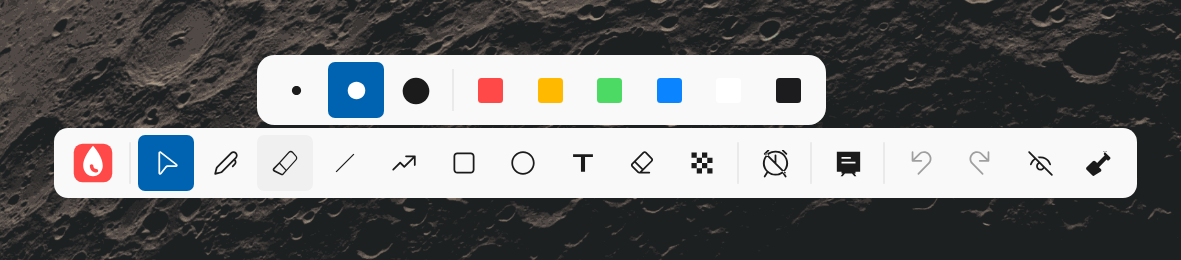
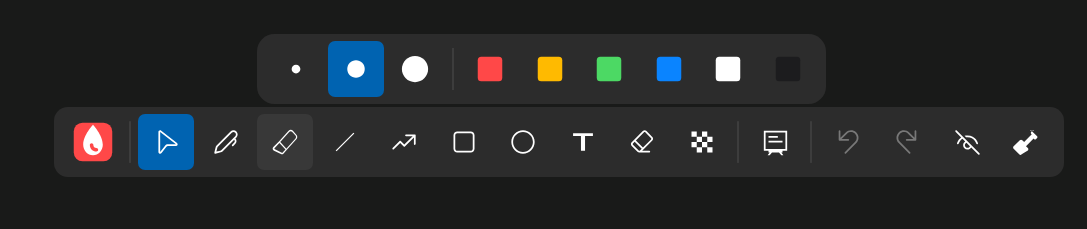
Drag the application icon on the toolbar to move it. Select Pen, then hold the left mouse button and drag to draw on the screen. Hover over or click a tool with options to adjust its color, size and other properties.
Return to your other apps
Choose Mouse, or press the default Ctrl + Alt + M, to click and type in the app underneath. Your marks can remain visible. Select a drawing tool or press Ctrl + Alt + D to resume annotating.
Esc first cancels a gesture or text edit, then clears a selection; otherwise it returns to mouse mode. To quit FloatInk, choose Exit in its tray menu. Closing Settings does not quit the app.
How long marks last
Marks belong to the current session and are not saved after quitting. Before quitting or updating, use a system screenshot or recording tool if you need a copy. Preferences and tool settings are saved, but marks do not return on the next launch.


02
Modes, boards and visibility #
Mouse interaction, board backgrounds and visibility serve different purposes.
Desktop, whiteboard and blackboard
Desktop annotation leaves your other apps visible. Whiteboard and blackboard provide opaque backgrounds for explanations. Entering either board starts annotation with your last annotation tool. Returning to the desktop background preserves marks and keeps drawing active.
Choose Mouse to restore a transparent desktop and interact with the app underneath. Board backgrounds are not separate documents: switching backgrounds uses the same marks.
Hide ink, hide toolbar, clear
The eye button hides ink, restores mouse interaction and collapses the toolbar to the app icon and eye button. Showing ink restores the previous tool and board. Fading marks may already have disappeared: hiding ink does not pause their deadlines.
Hiding the toolbar only hides its controls. Marks, shortcuts and mouse effects remain available. Clear marks removes annotations from every display, including disconnected displays, and clears undo history; it cannot be undone.
03
Drawing and editing #
Each tool keeps its own settings. Select a tool and adjust its options.
Pen, highlighter and shapes
Use Pen for freehand writing and Highlighter for translucent emphasis. Left-drag to place a line, arrow, rectangle or ellipse. Rectangles and ellipses offer outline and fill modes; arrows have style options.
Colors include red, yellow, green, blue, white, black and a custom picker with Hex input. Tools retain independent colors and sizes. Size and color shortcuts generally affect subsequent marks, not existing annotations. Filled shapes have no adjustable outline width.
Select, move, resize and delete
Use Select to click a mark or drag a rectangle around complete marks. Marquee selection includes only fully enclosed objects. Shift+click adds or removes a mark; Shift+drag adds enclosed marks. Hold Ctrl with a drawing tool for temporary selection.
Drag a selected mark or empty space inside its selection bounds to move the selection. A single resizable shape shows handles. Delete or Backspace deletes selected marks; a group move or deletion is one undo step. Dragging over existing marks with a drawing tool still draws new ink.
Esc cancels an active move or resize and restores its original state. Multi-object resizing, rotation, lasso selection and persistent grouping are not available.
Text
Choose Text and click to type; Enter adds a line. Clicking outside, changing tools or moving focus away commits the edit; Esc cancels it. Double-click existing text with Select or Text to edit it. Double-clicking with Pen continues drawing.
Text options include font, size, bold, italic and color. The editor grows with your text, including input-method composition, within screen bounds. Editing previously erased text replaces its layout and removes its old cuts; undo restores the previous state.
Eraser
Left-drag erases the swept area; a click erases a circular area. Right-drag removes entire touched marks. Choose one of three diameters. Each gesture is one undo step; an empty erase adds no history.
Partial cuts move and resize with the object and do not affect ink drawn later. Press Esc to cancel the active erase preview.
Mosaic
Choose Mosaic and drag over the area to obscure. Desktop samples refresh at the start of each stroke; existing mosaic marks do not continuously track changes underneath. Recheck coverage after changing pages, moving windows or scrolling.
Mosaic is a visual screen overlay and does not alter the original file. Before sharing, check that the actual screenshot or recording includes the overlay.
Undo and redo
Ctrl + Z undoes and Ctrl + Shift + Z redoes. History follows the order of edits across displays; a new edit clears redo. Up to 256 committed changes are retained. Automatically expired marks cannot be recovered through undo.
04
Presentations and multiple displays #
Help your audience follow along and control how much ink stays on screen.
Ink fade
Choose Off, 5, 15 or 30 seconds. Newly committed pen, highlighter, line, arrow, rectangle and ellipse marks fade after the hold time. Strokes committed no more than one second apart form a group so multi-stroke writing disappears together.
The fade lasts about 0.7 seconds. Changing the mode does not alter existing marks' deadlines. Text and mosaic do not fade automatically. Hiding ink or disconnecting a display does not pause deadlines.
Pointer highlight and click feedback
In Mouse options, enable pointer highlight and click feedback independently. Adjust size, halo color and left/right button colors. A left press shows one ring and a right press two; rings follow a held drag and fade after release.
Effects appear only in desktop mouse mode. Drawing, selection, erasing, opaque boards and hidden ink suspend them. Hiding only the toolbar does not. Effects do not become marks or undo steps.
Displays, sharing and recording
Each display has its own marks. Reconnecting the same display during the session restores them. Undo and redo skip disconnected displays. Clear marks still clears every display.
For meetings or recording, try sharing the whole display and confirm marks and mouse effects in the preview. Sharing one application window may omit FloatInk's separate overlays. Results depend on your recording or meeting software; test before presenting.
05
Keyboard shortcuts #
These are the Windows defaults. In-app Help shows your current assignments; change them on the Shortcuts page.
Shortcut scopes
Global shortcuts work while using other apps; annotation shortcuts apply during annotation. Annotation keys pause while editing text, colors, shortcuts or settings, so typing does not switch tools. Tab navigates focus on the toolbar and toggles toolbar visibility on the canvas.
Each command can have a binding in either scope or be left unassigned. Global bindings require modifiers or a function key. FloatInk rejects internal conflicts, but another app or the OS can still occupy a shortcut; check registration warnings in Settings. Esc and unmodified Delete/Backspace remain reserved for cancellation and deletion.
Size, color and previous tool
S cycles three sizes for the current tool; [ and ] decrease or increase size. C cycles preset colors; 1–6 select red, yellow, green, blue, white and black. Cycling from a custom color starts at red. Eraser, Mosaic, Mouse and Select have no ink-color setting.
Q swaps the last two explicitly selected annotation tools; temporary Ctrl selection does not change that pair. Shortcuts do not open tool options. Finish an active drawing or dragging gesture before changing its size or color.
| Action | While annotating | Global |
|---|---|---|
| Toggle annotation | — | Ctrl + Alt + D |
| Mouse mode | — | Ctrl + Alt + M |
| Show / hide toolbar | Tab | Ctrl + Alt + H |
| Select / Pen / Highlighter | V / P / H | — |
| Line / Arrow / Rectangle / Ellipse | L / A / R / O | — |
| Text / Eraser / Mosaic | T / E / M | — |
| Cycle size / Decrease / Increase | S / [ / ] | — |
| Cycle color / Preset colors | C / 1–6 | — |
| Previous tool | Q | — |
| Undo / Redo | Ctrl + Z / Ctrl + Shift + Z | — |
| Hide ink, board, fade, clear, mouse effects | — | — |
Mouse gestures and reserved keys (Esc, Ctrl selection, Shift selection, Delete/Backspace) are described in Drawing and editing above.
06
Settings #
Open Settings from the tray. Most changes apply immediately and persist across launches.
General
Choose the interface language, launch-at-login preference, startup notification, toolbar visibility on startup and confirmation before clearing marks. Launch at login is unavailable when the system service is unsupported.
Appearance
The theme can follow the system or stay light or dark. Set the accent independently to system or custom. Apply saves the custom color; Cancel or dismissing the picker discards the edit. The theme accent does not change ink colors.
Toolbar
Choose horizontal or vertical orientation, remember the toolbar position and hide optional buttons individually. The app drag icon, ink visibility button and Mouse remain available. Restoring default visibility does not reset orientation, shortcuts or tool styles.
Hiding a button does not disable its command: configured shortcuts still work. To edit a hidden tool's options, show its button again in Settings.
Shortcuts, About and Help
Shortcuts configures global and annotation bindings separately. About shows version, trial or activation status, update checks and third-party notices. Help includes an offline reference and your current shortcuts, plus the online manual.
07
Trial, activation and updates #
Features remain usable after the trial; activation removes the unactivated watermark.
30-day trial
Your first normal launch starts a 30-day full-feature trial. After expiry, features remain usable with an unactivated watermark on visible canvases. Check status in About or open activation from the tray. Pricing and purchasing channels follow the public release information.
Online and offline activation
Online: enter a valid activation key and submit; retry later if the network fails. Offline: export a .floatink-request file, obtain a .floatink-license through the issuer's channel, and import it in the app. Development builds may not have activation configured; follow the dialog's status.
Licenses bind to the installation identity. Normal uninstall preserves local settings and activation data. Contact the issuer for moving machines or an unreadable identity. Keep activation keys and customer license files private. After activation, subsequent launches verify the license locally without requiring a connection each time.
Check for updates
In About, choose Check for updates. If a new version is found, download and run its installer. Updating closes FloatInk, so capture any marks you need first. Network or verification failure leaves the existing installation in place; try again later. Builds without an update service explicitly show it as unavailable.
08
Troubleshooting #
Check modes and settings first, then the system or recording software.
The toolbar disappeared
Enable Show toolbar in the tray or use its configured shortcut (Ctrl + Alt + H by default). Seeing only the app icon and eye usually means ink is hidden: click the eye to restore it. Restore missing individual tools on the Toolbar settings page.
I cannot click the app underneath
Choose Mouse or press Ctrl + Alt + M. Whiteboard, blackboard and drawing mode receive screen input. If keyboard focus has not returned to the target app, click its window after switching to Mouse.
A shortcut does not respond
Check the current assignment in in-app Help and its scope. Finish text or color editing and try again. If a global combination is occupied, choose another in Settings. Complete drawing or dragging before using size and color commands.
Marks disappeared or cannot be restored
Check whether ink is hidden, fade is enabled or the display is disconnected. Expired, cleared or post-exit marks cannot be recovered. Hidden, unexpired marks can be shown again. Reconnect the same display during the session to restore its retained content.
Marks are missing from a recording
Try sharing a whole display instead of one application window and check the recording preview. FloatInk marks and mouse effects are separate overlays; capture behavior varies by software.
Data and feedback
On Windows, local settings, logs and activation data live under %LOCALAPPDATA%\Celerware\FloatInk and are preserved on uninstall. For a report, include Windows and FloatInk versions, reproduction steps and the error. Check screenshots for private content. Confirmed public support channels will be listed on the help page.